Use the church for orientation
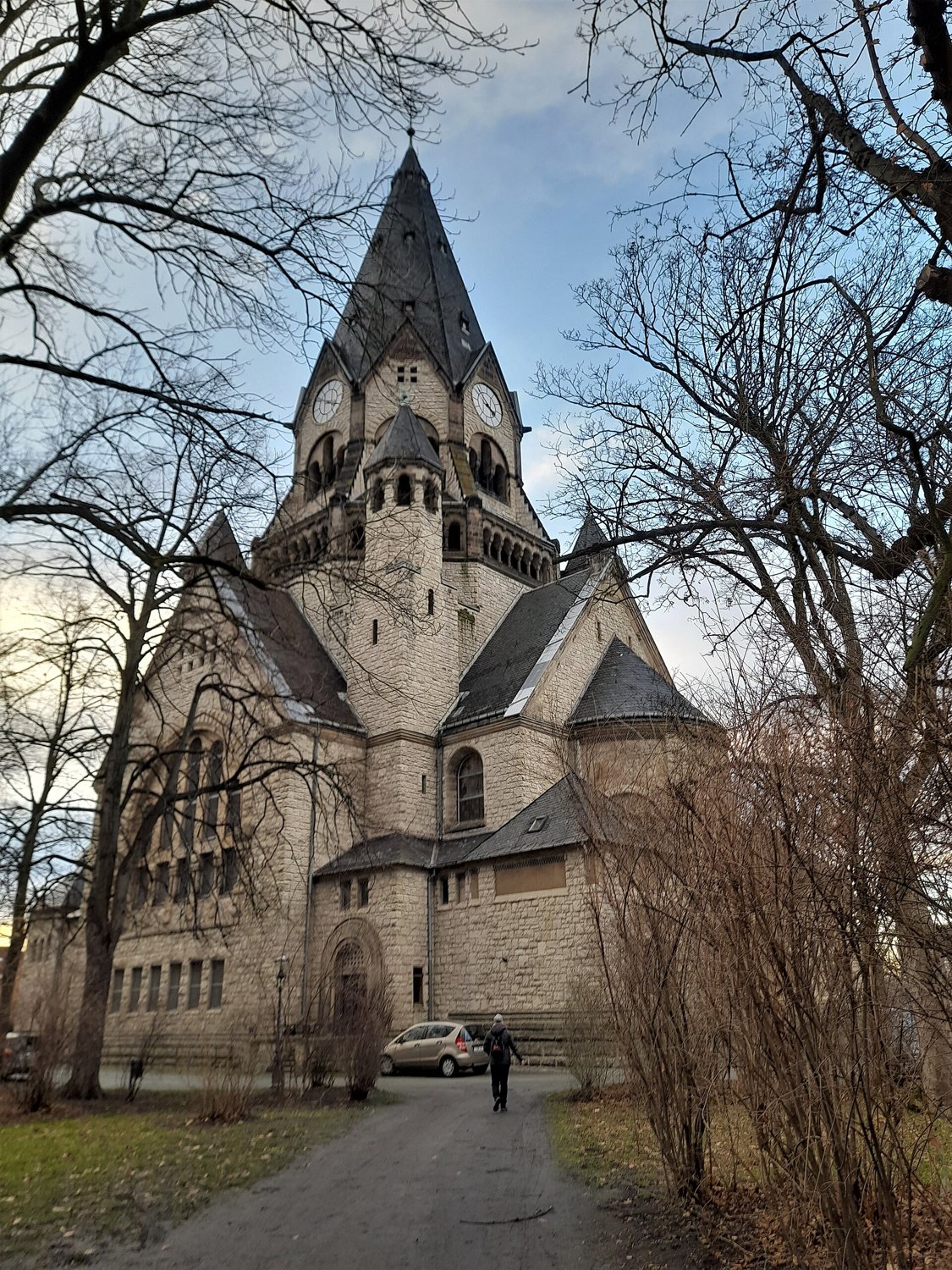
Lutherkirche provides a recognisable reference in the district. For a first walk, combine its exterior with a few neighbouring streets. This is different from visiting inside: services and events follow the parish calendar, while viewing from public routes needs less fixed planning.
Start from a position where the church can be seen in relation to nearby buildings. Then move closer to details where paths are accessible. The effect of a tower often becomes clearer from a distance. A picture taken directly beneath a façade instead records materials and decoration.
Compare phases of housing
The municipal area account places older development alongside post-war buildings in Lutherviertel. Comparing them is more rewarding than searching for one uniform style. Notice the positioning of houses, repeated windows and spaces between buildings. Which frontages make a continuous street edge, and where do greener gaps appear?
Choose a limited section. Walking every side street can make it harder to remember the specific differences that first attracted your attention. A note about two contrasting building arrangements may be more useful than many similar photographs. Accurate dates or architects' names, however, require a reliable account of the individual building rather than a guess based on appearance.
Consider a link towards the centre
Municipal planning material identifies Park der Opfer des Faschismus as a connection between the district and central areas. If including it, locate actual entrances and exits on the map. A park can provide a welcome break from streets, but it should not become an unplanned long extension to an otherwise compact circuit.
Its name also refers to remembrance. Treat any memorial areas with appropriate attention. Not every green space is simply a neutral setting for a break or a playful photograph.
Afterwards, return to the starting point or continue towards the centre. Distinguish those versions before setting off, especially if someone needs a shorter route. Lutherviertel works as a limited comparison of church architecture, housing and green space. It does not require a crowded programme of additional attractions to justify a visit. A clear focus also makes it easier to decide where to stop when weather or energy changes during the walk.