Start by finding your bearings
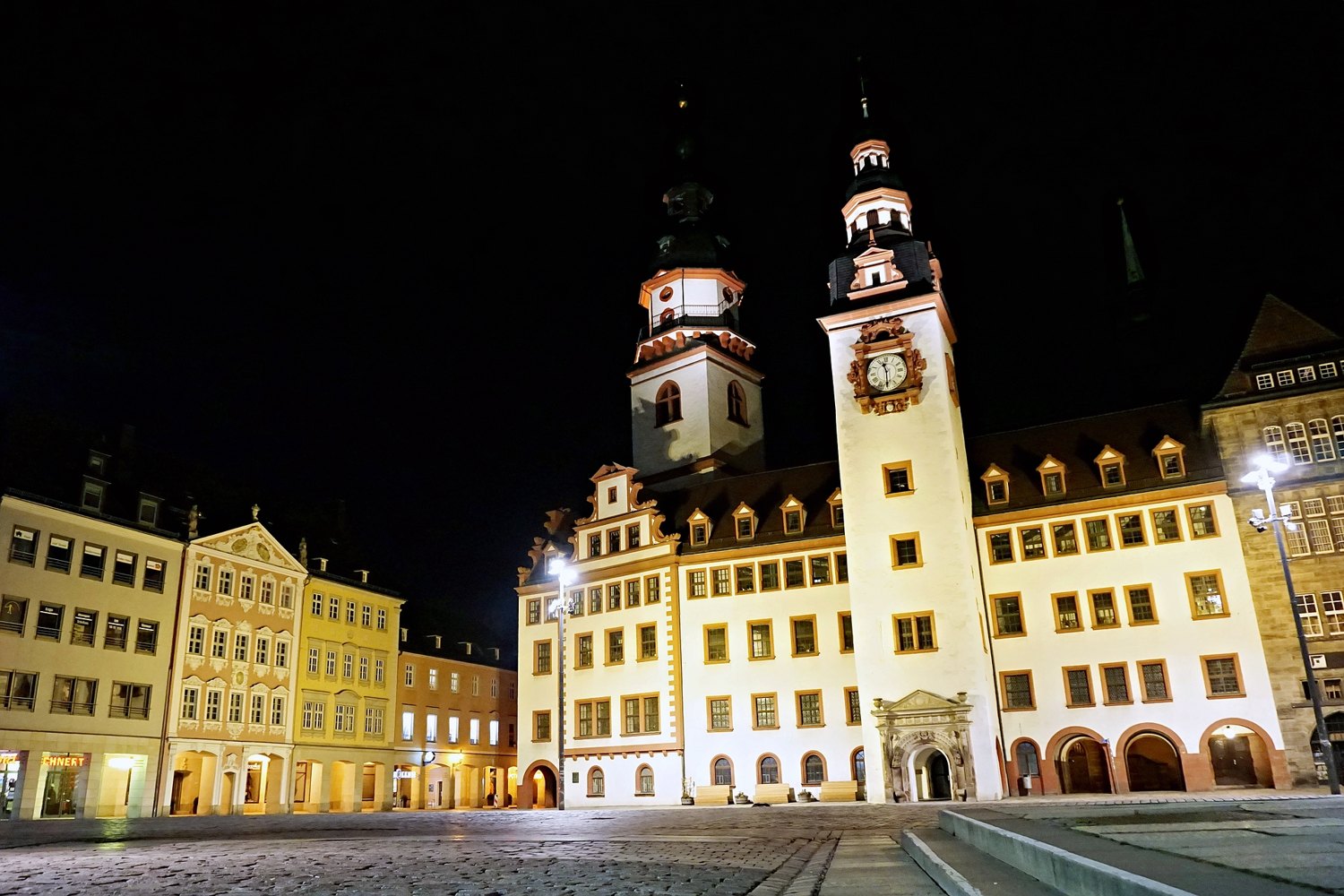
The market square is a useful starting point for a first visit to central Chemnitz. Before searching for several sights in succession, look at the town-hall side and the buildings opposite. Choose one feature you will recognise again, such as an entrance, a façade detail or the mouth of a street. It makes returning easier after exploring the smaller connections around the square.
This is a working city space rather than an enclosed open-air museum. People shop, go to work and cross it on ordinary errands. Stalls or events may change its layout on particular days. Adapt your circuit to what is happening. Standing exactly where a guidebook photograph was taken is rarely necessary; a position slightly to one side can provide an equally useful view without obstructing a route.
Understanding the two town halls
The Old and New Town Halls form a connected complex. The official tour explains that the newer section was added in 1911. From outside, the useful starting point is the relationship between the different parts. Look for changes in windows, materials and the rhythm of the frontage before trying to identify every decorative element.
Across the square, the baroque façade of the Siegert House provides a different scale. Consider it in relation to the civic buildings rather than treating it as another item to tick off. The town halls present a public frontage, while the smaller buildings around the square give the space another character. You can explore that contrast even when no guided visit is available.
If you enjoy sketching, begin with the roof outlines and add windows or portals on a second pass. Photographs benefit from the same approach: establish the setting, then examine details. A close crop may be attractive but difficult to place later. An additional wide picture preserves the relationship between the object that caught your eye and the square around it.
Give an interior visit its own appointment
The tourist information service offers a town-hall and tower tour. It can include representative interiors and the Hoher Turm. However, the town hall remains an administrative building, and the organiser notes that access to every room cannot always be guaranteed. Book for the overall visit rather than solely to see one particular hall from a photograph.
Check the current event listing for dates, registration and the exact meeting point. Save the full instructions: “outside the town hall” is too vague when there are several entrances. Ask in advance if stairs, prolonged standing or a tower ascent would be difficult. Another part of the tour may still suit you, but the organiser should confirm the arrangements rather than leaving you to discover them on arrival.
Avoid placing a booked tour immediately after your train is due in. A late arrival or time spent finding luggage storage could otherwise dominate the first part of the day. If you are already in the centre, use the exterior circuit to collect questions. Those questions often make a guided visit more rewarding than attempting to memorise the entire history beforehand.
Continue behind the town halls
A short extension towards Jakobikirche and Innere Klosterstraße changes the scale of the walk. Moving from the open square into smaller spaces makes the buildings easier to place within the centre. Keep the extension modest if a museum is already planned later; a useful loop does not need to become an exhaustive tour.
With children, choose one observation task, such as looking for differently shaped tower tops or figures. A sequence of dates is less useful for keeping attention on the actual buildings. Adults can add historical context afterwards. On the square, there is enough to notice in the shapes and proportions alone.
Choose a break according to the seating and businesses actually available that day. An old photograph cannot tell you whether a café is open or a market is occupying the space. A quieter neighbouring area may be preferable during an event. Finish with another look at the town-hall frontage. After walking around the block, its position and its relationship with the church are often clearer than they were on first arrival.